About Us

The Centre for Eurasian, Russian, and East European Studies (CEREES) at Queen Mary University of London brings people together to learn about Eurasia—inclusive of Russia, Ukraine, Belarus, East and Central Europe, the Baltics, Central Asia, and the Caucasus—and the region’s global connections.
Beyond an ‘area studies’ centre, CEREES situates the study of Eurasia within a cross-section of broader cross-disciplinary and cross-specialist concerns, ranging from globalism, transnationalism, and colonial and post-colonial migration, to memory politics, Cold War geopolitics, nationalism and multinationalism. We maintain that Eurasia is best understood when studied in dialogue with global developments, and that the region’s ‘particular’ experiences–be that relating to imperialism, revolution, or ideology–offer a rich vantage point from which to understand broader developments.
CEREES draws on expertise from across the Faculty of Humanities and Social Sciences (HSS) at Queen Mary, we partner with a range of national and international institutions, we foster innovative research and collaborations, and we host both scholarly and publics events designed to improve UK and international understanding of a complex region that remains at the heart of significant global developments.
CEREES supports a cross-disciplinary programme of networks, reading groups, training, collaboration, and coproduction. We remain committed to fostering opportunities for innovative scholarship and enhanced learning. Scholars and postgraduate students from inside and outside Queen Mary are welcome to seek support from and contribute to our programme.
Founded in 2023, CEREES builds on a long and rich tradition of Eurasian and East European expertise across the disciplines of History, Languages and Linguistics, Literature, Film, Drama, Politics, International Relations, Geography, Law, and Business Management at Queen Mary.
Following the full-scale invasion of Ukraine, in February 2022, CEREES seeks to play a formative role in reshaping approaches to the region. In particular, we seek to expand on established understandings of the politics, people, and culture of the Russian Empire/Soviet Union, focusing on Eurasian epistemologies (the various forms of local, imperial, and global knowledges), as well as the transnational connections and exchanges that help shape this region and the wider world.
For regular updates on our programme of events and other activities join the CEREES mailing list.
Request to join here: hss-cerees@qmul.ac.uk
CEREES Gallery
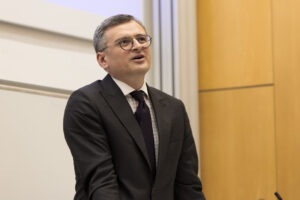
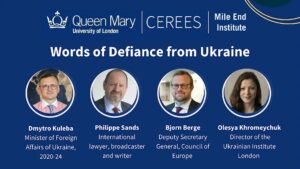
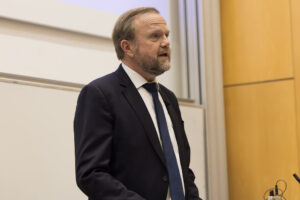
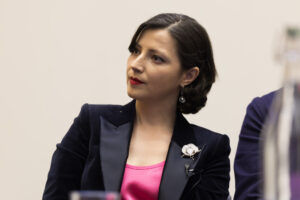
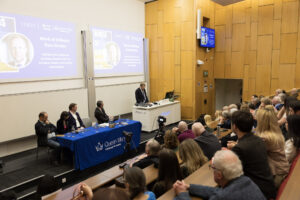
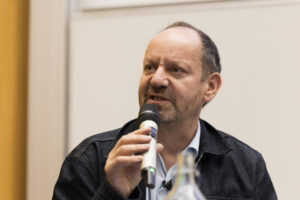
CEREES Panel – “Words of Defiance from Ukraine.” Pictured: Dmytro Kuleba (former Deputy Prime Minister and Foreign Affairs Minister of Ukraine); Bjørn Berge (Deputy Secretary General, Council of Europe); Philippe Sands KC (international lawyer, broadcaster and writer); Olesya Khromeychuk (Director, Ukrainian Institute London)

CEREES Discussion with Robert Chandler (CEREES affiliate), Edwin Frank (NYRB), and Maria Chehonadskih (QMUL) in the QMUL Chapel, surrounded by the sgraffito murals of renowned Polish artist and former inmate of the Soviet labour camps, Adam Kossowski. (More on the QMUL chapel murals and Kossowski here).

CEREES Lecture by William Blacker (UCL), chaired by Natalya Chernyshova (QMUL), in The Montagu Lecture Theatre, Queen Mary University of London.
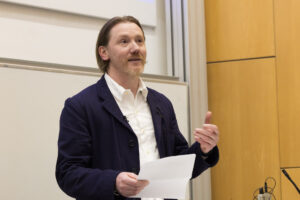 CEREES Director – Andy Willimott (QMUL), in The People’s Palace, Queen Mary University of London.
Our Research Themes
-
Decolonising Soviet studies
-
Soviet and Post-Soviet Temporalities
-
East London and the émigrés of Eurasia
-
Transnational entanglements
-
Humanitarianism
-
Eurasian epistemologies (cultural, social, political, scientific and medical knowledges)
Our Research Activities
-
Collaborative Doctoral Partnership with the British Library, Slavonic and East European Collection
-
Funded research projects
-
Our central programme of lecture, panels, and seminars (CEREES Events)
-
Public film screenings (CEREES Screenings)
-
Research networks and reading groups (CEREES Groups)
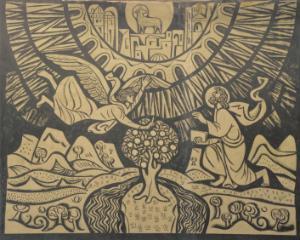
QMUL, St Benet’s chapel murals
The seventh panel portrays the final part of John’s revelation – a victorious image of the eternal city, the New Jerusalem, and its associated images of the Tree of Life and River of Life (chapter 21). Christ the Lamb of God is the light at its centre.
St Benet’s was rebuilt in 1962 as the University of London chaplaincy.
In 1964 the interior walls of the circular domed chapel were decorated with a series of unique murals, designed and executed by the renowned Polish ceramicist, Adam Kossowski.

Shape the Conversation
To join our mailing list, participate in our programme of events, or find out how we can support your research, please contact hss-cerees@qmul.ac.uk