CEREES Lecture


Monday 10 March, 18:00-20:00

‘Geopolitical shifts in Central Asia’s relationship with Russia after the invasion of Ukraine

Venue: Montagu Lecture Theatre, Graduate Centre (GC601), Queen Mary University of London, Mile End Road London E1 4NS

 [QMUL Campus Map linked here]


Book here: Eventbrite

About the Lecture:

Each major geopolitical event or crisis in the Eurasian region has animated discussions on whether the Central Eurasian region will overcome its condition as a periphery, cease being the ‘near abroad’ of the metropole or become further entrenched within the authoritarian regional institutional framework under Sino-Russian partnership. The protracted nature of Russia’s war on Ukraine has once again brought these questions to the fore. This lecture considers how Kazakhstan and Uzbekistan – the two largest states and emerging regional actors in Central Asia (Kazakhstan has been bestowed the status of a ‘middle power’) are signalling their autonomy and agency by advancing their visions of regional cooperation, infrastructural and trade connectivity, and balancing their memberships of multilateral organizations headed by Russia, China and Turkey [Eurasian Economic Union,EAEU; Collective Security Treaty Organization, CSTO; Shanghai Cooperation Organization, SCO; Organization of Turkic States, OTS).

About the Speaker:

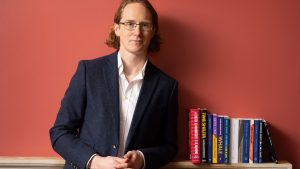
Dr Bhavna Dave is Senior Lecturer in Politics of Central Asia at SOAS. Her research focuses on geopolitics of the Eurasian region, ethnic and language policies, and state-society relations across Central Asia and labour migration in Eurasia. She is interested in the current reconfiguration of relations between Russia and states in the Eurasian region. She has published works on labour migration in Kazakhstan and Russia, language and ethnic identities, minorities, elections and patronage in Kazakhstan, EU-Central Asia relations, the role of the Russian Far East in Russia’s ‘pivot to Asia’ policy, social and security implications of China’s Belt and Road initiative in Central Asia, and India-Central Asia relations.

Her current research and writing are centred on: 1) Geopolitics and alliances in Eurasia, and the consequences of China’s Belt and Road initiative for Central Asian states and the Russian Far East; and 2) the political economy and legal framework of labour migration in Eurasia and effects on the migrant sending states. She has held positions as Visiting Research Scholar at the Institute of Developing Economies (IDE-JETRO) in Chiba, Japan, S. Rajaratnam Institute of International Studies (RSIS), Nanyang Technological University, Singapore, and Watson Institute, Brown University. She has taught masterclasses and short courses in Russian at numerous universities across Russia, Kazakhstan, Kyrgyzstan, and Tajikistan.

She was part of an Erasmus+ Project Eurasian Insights: Strengthening Central Asian Studies in Europe in 2018-2020 which developed online e-learning through a series of online lectures on YouTube and chapters in E-Handbook on Central Asia for teachers, students and experts.

She received her PhD from Syracuse University, New York. Her research has been supported by funding from British Academy, British Council, Open Society Foundation, IDE (Japan), MacArthur Foundation and research grants from SOAS. She is currently teaching postgraduate modules on State and Society in Central Asia and the Caucasus; Geopolitics and Security in Central Asia and the Caucasus; and an undergraduate module on Politics of Nationalism.

Event outline:

Welcome, by Andy Willimott & Jeremy Hicks (QMUL) – 18:00

Panel Discussion – 18:05

Discussion, chaired by Natalya Chernyshova (QMUL) – 18:50

Drinks reception, meet the speaker – 19:10


Shape the Conversation

To join our mailing list, participate in our programme of events, or find out how we can support your research, please contact hss-cerees@qmul.ac.uk


Pitch a new CEREES Group  /  Pitch a new CEREES Screening  /  Pitch a new CEREES Collaboration

CEREES-MEI Panel


Disinformation and Smearing in British Politics: 100 years since the Zinoviev Letter

Join the Centre for Eurasian, Russian, and East European Studies (CEREES) and the Mile End Institute (MEI) to mark the centenary of the most famous dirty trick in British political history, the ‘Zinoviev Letter’, and explore how how disinformation, ‘Fake News’ and smearing shape our politics today.


When: Tuesday, October 29, 2024, 6:30 PM – 8:00 PM
Where: Skeel Lecture Theatre, The People’s Palace, Mile End

Book here


About the Panel:

One hundred years ago this month, as voters prepared to go to the polls for the third time in two years, British politics was rocked by what would become the most famous ‘dirty trick’ in its long history: the ‘Zinoviev Letter’.

The Letter, encouraging the British proletariat to revolutionary fervour, was apparently sent by Grigori Zinoviev, head of Comintern, to the British Communist Party in September 1924. Its publication by the Daily Mail just before the General Election humiliated the first ever Labour government, headed by Ramsay MacDonald, when its political opponents used it to create a ‘Red Scare’ in the media. It was widely blamed for the Party’s defeat. Since it was first written a century ago, the Letter has been the subject of major Whitehall investigations in the 1960s and 1990s, and continues to crop up in the media, including during the Brexit referendum campaign and the 2017 general election.

With growing concerns about the impact of AI-driven disinformation on elections around the world, the Mile End Institute and the Centre for Eurasian, Russian and East European Studies are marking the centenary of the Letter’s publication by exploring how disinformation, ‘Fake News’ and smearing have affected, and continue to shape, British politics today. We will be joined by Dr Gill Bennett, Professor Ciaran Martin, Professor Jean Seaton and Dr Robert Saunders.


About the Speakers:

Gill Bennett was the Chief Historian of the Foreign Office from 1995 to 2005, and Senior Editor of its official history of British foreign policy, Documents on British Policy Overseas. She has worked as a historian in Whitehall for over forty years and is an expert on the history of secret intelligence. She is the author of Six Moments of Crisis: Inside British Foreign Policy and The Zinoviev Letter: The Conspiracy That Never Dies.

Ciaran Martin is Professor of Practice in the Management of Public Organisations at the Blavatnik School of Government at the University of Oxford. He was the founding Chief Executive of the National Cyber Security Centre (part of GCHQ) and over 23 years in the Civil Service, Ciaran held senior roles within the Cabinet Office and served as the Principal Private Secretary to the Cabinet Secretary and Head of the Civil Service between 2002 and 2008.

Jean Seaton is Professor of Media History at the University of Westminster, the Official Historian of the BBC, and the Director of the Orwell Foundation. She helped to found ‘Full Fact’ and is the author of a number of books on the history and role of the media in politics, including Power without Responsibility: Press, Broadcasting and the Internet in Britain and Pinkoes and Traitors: The BBC and the Nation, 1974-1987.

Robert Saunders is Reader in British History at Queen Mary University of London and Deputy Director of the Mile End Institute. He is a regular commentator on British politics and author of Democracy and the Vote in British Politics and Yes to Europe: The 1975 Referendum and Seventies Britain.


This event will be held in the Skeel Lecture Theatre in the People’s Palace, which is number 16 on this map of Queen Mary’s campus in Mile End. Doors will open at 6pm and we aim to start at 6.30pm sharp.


Shape the Conversation

To join our mailing list, participate in our programme of events, or find out how we can support your research, please contact hss-cerees@qmul.ac.uk


Pitch a new CEREES Group  /  Pitch a new CEREES Screening  /  Pitch a new CEREES Collaboration

CEREES Panel & Launch


Monday 3 February, 18:00-20:30

‘New Directions in Ukrainian Film History’

Launch of joint special issue of Culture of Ukraine (Kharkiv) & Studies in Russian and Soviet Cinema


Venue: Queen Mary University of London, Mile End Road London E1 4NS [The precise location of this panel will be circulated to all registered ticket holders],  [QMUL Campus Map linked here]

And online through Zoom. This will be a hybrid event


Book here: Eventbrite


About the Panel:

In 2024 the journals Culture of Ukraine and Studies in Russian and Soviet Cinema collaborated to produce a joint special issue devoted to Ukrainian film history. The English language edition came out in October 2024 and the Ukrainian language edition is due out in Spring 2025. This panel will discuss and reflect on the unique experience of the collaborative publishing venture and consider how to build on it.

The event will include English and Ukrainian language interventions and there will be consecutive translation.

About the Speakers:

Leonid Machulin (Khar’kiv State Academy of Culture)

Jeremy Hicks (School of the Arts, Queen Mary University of London, UK)

Oleksandr Bezruchko (Department of Cinema and TV, Kyiv National University of Culture and Arts, Kyiv, Ukraine)

Vincent Bohlinger (Rhode Island College, Providence, RI, USA)

Nataliia Cherkasova (Department of Film and Television Directing and Screenwriting, Kharkiv State Academy of Culture, Kharkiv, Ukraine)


Event outline:

Welcome, by Andy Willimott & Jeremy Hicks (QMUL) – 18:00

Panel Discussion – 18:05

Drinks reception, meet the speakers – 19:30

Finish – 20:30


Shape the Conversation

To join our mailing list, participate in our programme of events, or find out how we can support your research, please contact hss-cerees@qmul.ac.uk


Pitch a new CEREES Group  /  Pitch a new CEREES Screening  /  Pitch a new CEREES Collaboration

CEREES Panel


Monday 10 February, 18:00-20:30

‘The British Left and Ukraine’

Venue: Queen Mary University of London, Mile End Road London E1 4NS [The precise location of this panel will be circulated to all registered ticket holders]

 [QMUL Campus Map linked here]

Book here: Eventbrite

About the Panel:

The election of a UK Labour government and rise of independent and left of Labour voices in Westminster prompts the question as to the relation of the UK left to Ukraine. While many elements of British society, including in universities and the armed forces were not sufficiently attentive to Ukraine prior to Russia’s full-scale invasion in 2022,  this panel will seek to consider whether the UK left specifically has had and still has a blind spot with regard to Ukraine, and (insofar as this is the case) why that is, and whether it is likely to change. Panelists will approach the historical and contemporary political aspects of this question, considering how it plays out in various UK political organisations and institutions, while also considering how this looks from the Ukrainian perspective.

About the Speakers:

Paul Mason is journalist, with columns in The New European, Social Europe, and Frankfurter Rundschau. He was Business Correspondent and then Economics Editor of the BBC Two television programme Newsnight from 2001, and Culture and Digital Editor of Channel 4 News from 2013, becoming the programme’s Economics Editor in 2014. He left Channel 4 in 2016. He is the author of several books, and a visiting professor at the University of Wolverhampton.

Christopher Ford is organiser of the Ukraine Solidarity Campaign, he has written number of books and articles on Ukrainian labour history including: ‘Ukapisme – Une Gauche perdue,’ ‘Le marxisme anti-colonial dans la révolution ukrainienne 1917–1925,’ and is editor of Ivan Maistrenko’s, ‘Borotbism: A Chapter in the History of the Ukrainian Revolution.’

Yuliia Yurchenko is a Senior Lecturer and researcher in political economy at University of Greenwich. She is currently in Ukraine on an extraordinary leave. And while she writes that she is, for the moment, in relative safety, that could change any moment. Being a Ukrainian, an activist and an academic, Yuliya traveled to Ukraine on Feb 19, 2022 as part of a fact-finding and solidarity mission with a number of MPs, trade unionists and journalists. The goal, she says, of this mission is to connect with civil society organizations, trade unions, activists and politicians, and “to express direct, cross-border solidarity from the UK working class to the Ukrainian working class.”

Richard Johnson is a Senior Lecturer in Politics and International Relations. He has published extensively on UK politics, especially Labour Party history. He is the co-author (with Mark Garnett & Gavin Hyman) of Keeping the Red Flag Flying: The Labour Party in Opposition since 1922 (Polity, 2024). He has published academic research on British women’s opposition to the Common Market, Labour’s changing policy on Europe under Neil Kinnock, the history of the European Parliamentary Labour Party, Theresa May’s record on LGBT rights, and Jeremy Corbyn’s foreign policy outlook (with Mark Garnett). He has written profiles of prominent Labour figures for Tribune, including Michael Foot, Barbara Castle, Peter Shore, and Anne Kerr, as well as a reflection on Englishness and the Left.


Event outline:

Welcome, by Andy Willimott & Jeremy Hicks (QMUL) – 18:00

Panel Discussion – 18:05

Discussion, chaired by Natalya Chernyshova (QMUL) – 18:50

Drinks reception, meet the speakers – 19:30

Finish – 20:30


Shape the Conversation

To join our mailing list, participate in our programme of events, or find out how we can support your research, please contact hss-cerees@qmul.ac.uk


Pitch a new CEREES Group  /  Pitch a new CEREES Screening  /  Pitch a new CEREES Collaboration

CEREES Discussion & Book Launch


Monday 2 December, 18:00-20:00

‘Decolonising the (Post-)Soviet Screen’

Venue: Queen Mary University of London, Mile End Road London E1 4NS — The exact room will be emailed to registered attendees in advance.

 [QMUL Campus Map linked here]


Book here: Eventbrite


About the Panel:

Decolonising the (Post-)Soviet Screen explores the ambivalent legacies of the Soviet Union through a cinematic lens, applying decolonial perspectives. The authors of this edited book come at the topic from different angles and different cultural and disciplinary backgrounds, exploring how decolonial viewpoints can prompt a re-evaluation of what constitutes ‘Russian’/’Soviet’ culture, extending beyond cinema to encompass the entire cultural sphere. Featuring Assiya Issemberdiyeva (QMUL), Anisa Sabiri (filmmaker and independent scholar), Serian Carlyle (SSEES-UCL), Dusan Radunovic (Durham), Natascha Drubek (Apparatus Press and SSEES-UCL) tbc, Irina Schulzski (Apparatus and Hagen) tbc.

About the Speakers:

Assiya Issemberdiyeva is a PhD student at the School of Languages, Linguistics and Film, Queen Mary, University of London. She studied Journalism at the Al-Farabi Kazakh National University (BA, MA) and Film Studies at the Queen Mary University of London (MA). In 2021 she obtained a Collaborative Doctoral Award in Visual Cultures funded by the Arts and Humanities Research Council through the London Arts and Humanities Partnership with a thesis on British attitudes to the representation of Soviet Non-Slavic identities. Her project looks at the representation of Central Asian narratives in wartime Soviet cinema and the structure within which it was produced, analysing its reception both in the USSR and in Great Britain. The working title of her thesis is British Attitudes to Non-Russian Identities in World War Two Campaigns for British Aid to the Soviet Union.

Adelaide McGinity-Peebles (FHEA) is a Lecturer in Film and Television Studies in the Department of Communications, Drama and Film at the University of Exeter. Her research focus is on contemporary Arctic, post-Soviet, and Indigenous film and media. Her recent research project (sponsored by the Leverhulme Trust) investigated the representations of the Russian Arctic in contemporary film. From this project, she is currently completing a monograph titled Russian Arctic Cinema: Figurations of the Russophone North in Contemporary Film, under contract with Edinburgh University Press. She has published on the topics of ethnicity, race, gender, sexuality, and the environment in Arctic, post-Soviet, and Central Asian film and media. 

Anisa Sabiri is a filmmaker and teacher based at the University of Central Asia in Naryn. Her work focuses on concepts of identity and memory, and the search for an indigenous Central Asian language in cinema.  For several years, she worked as a tour guide in the Pamir mountains while building her profile as an avant-garde novelist, photographer and activist, before making her shorts Nolai Tanbur / The Crying of Tanbur (2018) and Az Alla To Vobalam / Rhythms of Lost Time (2021), featured at the Busan International Film Festival, Dokumenta-15, BOZAR, Asian Film Archive and other platforms and festivals worldwide. Sabiri is also an active promoter of the horizontal-based network in Central Asian art and education. She has been guest lecturing and running workshops for filmmakers with the University of Central Asia, Open Society, Internews, the Institute for War and Peace, and was a speaker at international platforms and events associated with European Film Market, UNESCO, TED Mastercard, Basel Peace Forum. Her film projects in development were featured at Berlinale, Ji.hlava International Film Festival, Sheffield IFF, CineDoc Tbilisi, and goEast East-West Talent Lab, among others. She holds an MA in Screenwriting from the London Film School with the support of the UK-government CHEVENING Scholarship, from which she graduated with the Outstanding Screenwriting Award in 2021. She is an alumna of the Busan Asian Film Academy, EFM Doc Toolbox-23, and the Sheffield Future Producers School. She is a member of Directors UK and the Documentary Association of Europe.

Serian Carlyle is a PhD student at UCL SSEES, funded by a Wolfson Postgraduate Scholarship in the Humanities. For her PhD, she is analysing the production of youth cinema at the Gorkii studio in the late Brezhnev period, to demonstrate how the models of ideal young heroes in different genres reflect the state’s national and racial anxieties. She previously co-authored a chapter on the depiction of abortion in Soviet cinema with Dr Rachel Morley, published in Gender and Authority across Disciplines, Space and Time, edited by Adele Bardazzi and Alberica Bazzoni. Outside academia, she has worked in charities, particularly around issues of anti-oppression and diversity.

 Dusan Radunovic is Associate Professor/Director of Studies (Russian) in the School of Modern Languages and Cultures, where he teaches Russian social and cultural history and film studies. He is the author of a monographs on the genesis of the concept of form in the twentieth-century Russian humanities (forthcoming) and on Mikhail Bakhtin (in Serbo-Croat, 2012) and co-editor of the volume Language, Ideology, and the Human: New Interventions (Routledge, 2012). His monograph on the concept of form in twentieth- century Russian humanities is being prepared for publication.

Natascha Drubek-Meyer is a researcher, author and editor in the area of Central and East European literature, film and media. Since 2012 Drubek has been teaching comparative literature, and film and media studies, at the Free University of Berlin (in 2020-21 as professor of the FONTE-Stiftung]. Drubek is one of the developers of Hyperkino and the editor-in-chief of the open-access academic journal Apparatus.

Irina Schulzki is the publishing director of the journal Apparatus. Film, Media and Digital Cultures in Central and Eastern Europe. She has authored book chapters and journal articles on gesture across film, literature, and art; fan fiction; theories of the comical; phenomenology and media; Mikhail Shishkin’s prose; and Kira Muratova’s cinema. Among her edited publications is Decolonising the (Post-)Soviet Screen, with Heleen Gerritsen (Apparatus Press, 2024). She is currently completing the co-edited volume (with Irina Gradinari), ReFocus: The Cinema of Kira Muratova (under contract with Edinburgh University Press, forthcoming 2025).
Event outline:

Welcome, by Andy Willimott & Jeremy Hicks (QMUL) – 18:00

Panel Discussion – 18:05

Discussion, chaired by Natalya Chernyshova (QMUL) – 18:50

Drinks reception, meet the speaker – 19:10


Shape the Conversation

To join our mailing list, participate in our programme of events, or find out how we can support your research, please contact hss-cerees@qmul.ac.uk

 

Pitch a new CEREES Group  /  Pitch a new CEREES Screening  /  Pitch a new CEREES Collaboration

CEREES Panel


Monday 18 November, 18:00-20:00

‘Political prisoners in Russia and the Occupied Territories of Ukraine’

[Prisoner hands, Vecteezy]

Book here: Eventrbite


About the Panel:

Russia’s prisons are the unseen side of Russia’s repression of dissent and opposition. This event includes UK experts on the Russian legal and penal system (Profs Judith Pallott, Helsinki; and Bill Bowring, Birkbeck), alongside campaigners for prisoners’ rights in Russia (Sergei Davidis, Memorial), and in the territories of Ukraine, temporarily occupied by Russia (Yevgeniy Zakharov, director of the Kharkiv Human Rights Protection Group).

About the Speakers:

Prof Judith Pallot is the research lead for “Gulag Echoes,” a 5 year project funded by the European Research Council and conducted at the Aleksanteri Institute, University of Helsinki. The project’s aim is to examine the impact of the system of penality developed in the Soviet gulag on the ethnic identification, social relationships and political association of prisoners in the Soviet Union and the communist successor states. The proposition underpinning the research is that prisons are sites of ethnic and racial identity construction, but that the processes involved vary within and between states, and through time.

Prof Bill Bowring is a practising barrister and Professor of Law at Birkbeck, where he teaches international law and human rights. He is Chair of the European Human Rights Advocacy Centre (EHRAC), taking cases to the European Court of Human Rights; is President of the European Lawyers for Democracy and Human Rights (ELDH); is active in the Bar Human Rights Committee of England and Wales; and is a Trustee of the Redress Trust, and of Lawyers for Palestinian Human Rights (LPHR). Bill is presently writing several articles and book chapters on Russia, minority and language rights; the relationship between the Constitutional Court and the European Court of Human Rights; and the Eurasian Economic Union.

Sergei Davidis is Head of Political Prisoners Support Program and Member of the Council at the Memorial Human Rights Center. He was educated in Sociology at Moscow State University and on Law at Moscow State Law Academy. For many years, he was a participant and one of the organizers of the democratic opposition movement. His research interests are closely related to activities to support political prisoners in Russia, and he studies the sociological and legal aspects of politically motivated deprivation of liberty, in particular, in the context of world practice and international norms.

Yevhen Zakharov is a human rights defender, journalist, and editor-publisher. He is board chair of the Ukrainian Helsinki Human Rights Union and director of the Kharkiv Human Rights Protection Group. For his work in civil rights, he has been awarded the Order of Liberty (2008) and the Order for Intellectual Courage (2006), the Vasyl Stus Prize (2012), and the Lev Kopelev Prize (2015).


Event outline:

Welcome, by Andy Willimott & Natalya Chernyshova (QMUL) – 18:00
Panel Discussion – 18:05
Discussion, chaired by Jeremy Hicks (QMUL) & Simon Pirani (Durham) – 18:50
Drinks reception, meet the speaker – 19:20

Shape the Conversation

To join our mailing list, participate in our programme of events, or find out how we can support your research, please contact hss-cerees@qmul.ac.uk
 

Pitch a new CEREES Group  /  Pitch a new CEREES Screening  /  Pitch a new CEREES Collaboration

CEREES Events, 2023-24


Our central programme of lectures, panels, and seminars bring people into conversation with leading experts on Eurasia and showcase the latest research on the region.


Autumn 2023


Inaugural CEREES Lecture

___________

William Blacker, ‘The Many Voices of Ukraine’

Monday 30 October, 2023


CEREES Book Talk

___________

Alessandro Inadolo Arrested Development: The Soviet Union in Ghana, Guinea, and Mali 1955-1968

Monday 20 November, 2023


CEREES Lecture

___________

Sergey Zherebkin ‘The Online Ukraine War: Russo-Ukrainian Social Media Debates on Politics and Culture’.

Monday 11 December, 2023


Spring 2024


CEREES Book Launch

___________

Svetlana Payne on Mikhail Osorgin’s The Riven Heart of Moscow

Wednesday 24 January, 2024


CEREES Screening & Book Launch

___________

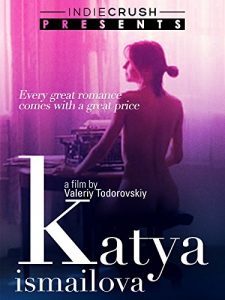
Screening and Discussion of Katia Izmailova (Valerii Todorovskii 1994) and launch of A History of Russian Literature on Film by David Gillespie and Marina Korneeva

Monday 29 January, 2024


CEREES Lecture

___________

Natalya Chernyshova ‘Out of the marshes and into the nuclear age:

the politics of modernisation in late Soviet Belarus, 1965-1980′

Monday 26 February, 2024


CEREES Book Launch

___________

Robert Chandler on Andrei Platonov’s Chevengur

with Edwin Frank (editorial director of The New York Review of Books)

Monday 18 March, 2024


CEREES Book Discussion

___________

Tamara Popic, Health Reforms in Post-Communist Eastern Europe. 

Discussants: Dr Eleanor Brooks (School of Social and Political Science, University of Edinburgh) and Dr Allan Sikk (School of Slavonic and East European Studies, University College London)

Wednesday 20 March, 2024


CEREES Lecture

___________

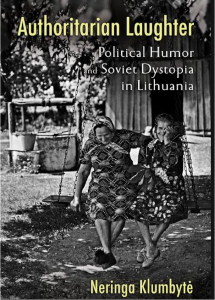
Neringa Klumbytė (Miami University), ‘Authoritarian Laughter: Political Humor and Soviet Dystopia in Lithuania’ 

Speaking on the topic of her award-winning book, Neringa Klumbytė will examine the of humour in times of repression and war.

Monday 8 April, 2024


Summer 2024


CEREES Lecture & Archive Talk

___________

Igor Cașu (National Agency of Archives, State University of Moldova),

‘Soviet Famine in Moldova:

Why was the Soviet famine of 1946-7 the most severe in the Moldavian SSR?

Preliminary conclusions based on Chișinău, Kyiv, and Moscow archives’

Wednesday 8 May, 2024


CEREES Mini-Series

___________

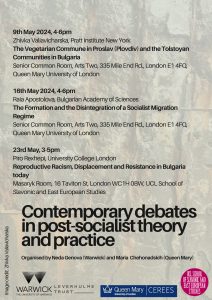
CEREES Mini-Series: ‘Contemporary Debates in Post-Socialist Theory and Practice’

Featuring:

Zhivka Barbarianna (Pratt Institute, New York), Raia Apostolova (Bulgarian Academy of Sciences), and Piro Rexhepi (UCL).

Organisers:

Neda Genova (Warwick) & Maria Chehonadskih (QMUL)

9 May, 16 May, and 23 May, 2024


CEREES Lecture and Archive Talk


Wednesday 8 May, 2024, 18:00-20:00


Soviet Famine in Moldova:

Why was the Soviet famine of 1946-7 the most severe in the Moldavian SSR? Preliminary conclusions based on Chișinău, Kyiv, and Moscow archives


Igor Cașu

(National Agency for Archives, State University of Moldova)


Venue: Montagu Lecture Theatre, Graduate Centre (GC601), Queen Mary University of London, Mile End Road London E1 4NS

[QMUL Campus Map linked here]

Book here: Eventbrite


About the Event:

The Soviet famine of 1946-1947 is the last and the least researched famine in the USSR’s history. The reference books on the postwar famine are outdated conceptually and empirically (Zima, 1996) or limited mainly to the international context (Ganson, 2009). As a few recent books or articles on the Soviet famine of 1931-1933 show (Ohayon (2006), Kindler (2018), Cameron (2018), and Pianciola (2019), the clue to understanding the famine phenomena is to address the regional dimension and embark on a multidisciplinary approach. For at least one-quarter of a century, it is acknowledged that the Soviet postwar famine was the most severe proportionally in the Moldavian SSR. Ten times more people died, proportionally, in present-day Moldova than in Russia, and five times more than in Ukraine (Ellman, 2000). Igor Cașu uses unpublished archival materials from Moldova, Ukraine, and Russia to explain why according to the three main indicators of the famine – dystrophy, excess deaths, and cannibalism – it was most devastating in the Moldavian SSR, indeed in the historical Bessarabia, including in areas given to Ukraine, in the north, and especially south, in the strategically important areas on the Black Sea coast and Danube mouths.

Igor Cașu’s opening lecture will be followed by an archive talk on using the National Archives of Moldova, Ukraine, and Russia, drawing on his experience as Director of the National Agency for Archives at State University of Moldova.


About the Speaker:

Igor Cașu is the director of the National Agency for Archives, since April 2022, and a Lecturer at the State University of Moldova, Chișinău, since September 1998. He defended his Ph.D. thesis in March 2000 at the Iași University in Romania on “Nationalities policy in Soviet Moldavia, 1944-1989”. From January to June 2010, he was deputy chairman of the Presidential Commission for the Study of Communist Totalitarian Regine in the Republic of Moldova in charge of research on “Political Repressions from 1953 to the late 1980s”. In February-August 2016 he was a Fulbright Scholar at Stanford University giving talks on postwar famine at Toronto University, Yale, Harvard, and Stanford. In March 2020 he was NEC Visiting Scholar at Davis Center, Harvard University. His recent publications include “The Benefits of Comparison: Famine in Kazakhstan in the Early 1930s in Soviet Context”, in Journal of Genocide Research, Volume 22, issue 3, 2020, and “Do Starving People Rebel? Hunger Riots as Bab’y Bunty in Spring 1946 Soviet Moldavia”, in New Europe College’s Yearbook (Bucharest), 2020 and “Police vs. Party? Institutional Hierarchies and Agency in Soviet Moldavia, 1944-1952”, in Contemporary European History, vol. 32, no. 1, 2022. He is working on a book on the postwar famine in Soviet Moldavia in the European context, 1946-47.


Event outline:

Welcome and introduction – 18:00

Lecture: Soviet Famine in Moldova – 18:10

Moldavian Archive overview – 18:40

Q&A, chaired by Natalaya Chernyshova (QMUL) – 18:50

Drinks reception, meet the speaker – 19:10

CEREES Lecture

Monday 8 April, 2024, 18:00-20:00


Authoritarian Laughter: Political Humor and Soviet Dystopia in Lithuania

Neringa Klumbytė (Miami University)


Venue: TBC Queen Mary University of London, Mile End Road London E1 4NS

[QMUL Campus Map linked here]

Book here: Eventbrite


About the Event:

Speaking on the topic of her award-winning book, Neringa Klumbytė will examine the role of humour in times of repression and war. In the Soviet Union official humor was a propaganda tool for instituting communist ideology and governing society. In Soviet Lithuania, paradoxically, while official humor institutions involved people in co-governance through the intimacy of laughter, they also created critical publics who shared dystopian visions of Soviet modernity via authoritarian state sponsored venues. These critical publics were mobilized in anti-Soviet revolutionary laughter in the late 1980s and early 1990s. In Soviet times, during the collapse of the USSR, or recently the war in Ukraine, humor has served as a medium of political participation and emancipation for a national cause.


About the Speaker:

NERINGA KLUMBYTĖ is Professor of Anthropology and Russian and Post-Soviet Studies and Director of the Lithuania Program at the Havighurst Center for Russian and Post-Soviet Studies, Miami University. She is the author of Authoritarian Laughter: Political Humor and Soviet Dystopia in Lithuania (Cornell UP, 2022), the winner of the British Association for Slavonic and East European Studies Women’s Forum prize; a co-author of Social and Historical Justice in Multiethnic Lithuania (2018), and co-editor of Soviet Society in the Era of Late Socialism, 196485 (2012, with Gulnaz Sharafutdinova).


Event outline:

Welcome and introduction – 18:00

Discussion, chaired by Natalaya Chernyshova (QMUL) – 18:10

Drinks reception, meet the speaker – 19:30

Post-Communist Studies Group


The Post-Communist Studies Group is a cross-institutional, interdisciplinary collaboration formed by Neda Genova (Warwick University) and Maria Chehonadskih (QMUL) to investigate the spatio-temporal arrangements and experiences of post-Socialist Europe.


[Webpage under construction!]


Events:

CEREES mini-series: “Contemporary Debates in Post-Socialist Theory and Practice”, with support from the Centre for Eurasian, Russian, and East European Studies at QMUL and the Leverhulme Trust.


Shape the Conversation

To form part of the conversation on Eurasia, participate in our groups and programme of events, or find out how we can support your research, please contact the Centre Director Dr Andy Willimott (a.willimott@qmul.ac.uk).


Pitch a new CEREES Group  /  Pitch a new CEREES Screening  /  Pitch a new CEREES Collaboration