The Project
“Hidden in Plain Sight: Historical and Scientific Analysis of Premodern Sacred Books” (HiPS) is a major research project funded by the UK’s Arts and Humanities Research Council (AHRC) and dedicated to the study of the material history of sacred texts. The project investigates how premodern religious books and textual ritual objects were used, modified, and transformed through time. Rather than treating these items as static artefacts preserved in libraries and museums, the project approaches them as dynamic objects that have been handled, altered, and interpreted by generations of users.
Across religious traditions and geographical contexts, sacred texts were often subject to physical intervention. Pages were erased, images altered, pigments degraded, and texts embedded into ritual objects or clothing. By combining historical research with advanced scientific analysis, Hidden in Plain Sight seeks to recover these hidden histories of interaction.
The project researches a wide range of materials, including Jewish and Christian religious books, Islamic talismans, and Himalayan Buddhist ritual textiles. Through this comparative approach, the project explores how communities across cultures engaged materially with sacred texts and objects, revealing patterns of tactile devotion, expurgation, ritual praxis, and careless handling.
A Multidisciplinary Approach
A central goal of the project is to develop a new model for studying premodern sacred books through close collaboration between the humanities and the sciences. The project brings together historians, heritage scientists, conservators, librarians, archivists, technicians, and museum curators. Detecting erased pigments, altered surfaces, or microscopic residues requires specialised equipment and scientific expertise, while interpreting the significance of these findings depends on knowledge of historical context, manuscript culture, and archival data. Each discipline contributes a distinct perspective, enabling the team to examine manuscripts both as historical documents and as complex material artefacts. The project therefore operates at the intersection of laboratory and library, using scientific analysis not only to identify materials but also to address broader historical questions about how sacred texts were produced, modified, and used.
Core Research Strands
Research within Hidden in Plain Sight was originally organised into three interconnected strands, each focusing on different historical contexts of material alteration. The first explores the interreligious dynamics of Jewish–Christian relations, examining how both tension and exchange shaped the physical modification of sacred texts. The second focuses on the English Reformation, analysing case studies of textual and material alteration arising from this period of religious upheaval. The third strand expands the scope beyond Europe by investigating sacred texts in ritual use, including Muslim and Himalayan Buddhist objects, to provide a broader comparative perspective.
Together, these strands offer a framework for understanding how and why sacred materials were altered across cultures, leading to more nuanced and far-reaching conclusions. As the project has developed, the theme of erasures has emerged as a central focus across all strands. In response, a mock-up experiment was initiated to establish a scientific basis for identifying and classifying the material signatures associated with different methods of erasure.
Jewish-Christian
Within the Jewish–Christian Books research strand, the project has examined a fifteenth-century Ashkenazi Jewish prayer book that bears the marks of multiple censorship campaigns. By employing advanced optical imaging techniques, we have reconstructed the chronological sequence of these interventions. This research offers a unique window into how the materiality of Jewish sacred manuscripts was gradually reshaped in response to changing religious environments over time.
Reformation
The second strand focuses on manuscripts and printed books affected by the religious and political upheavals of the early modern Reformation. During this period, sacred texts were frequently altered in response to rapidly changing theological and political contexts.
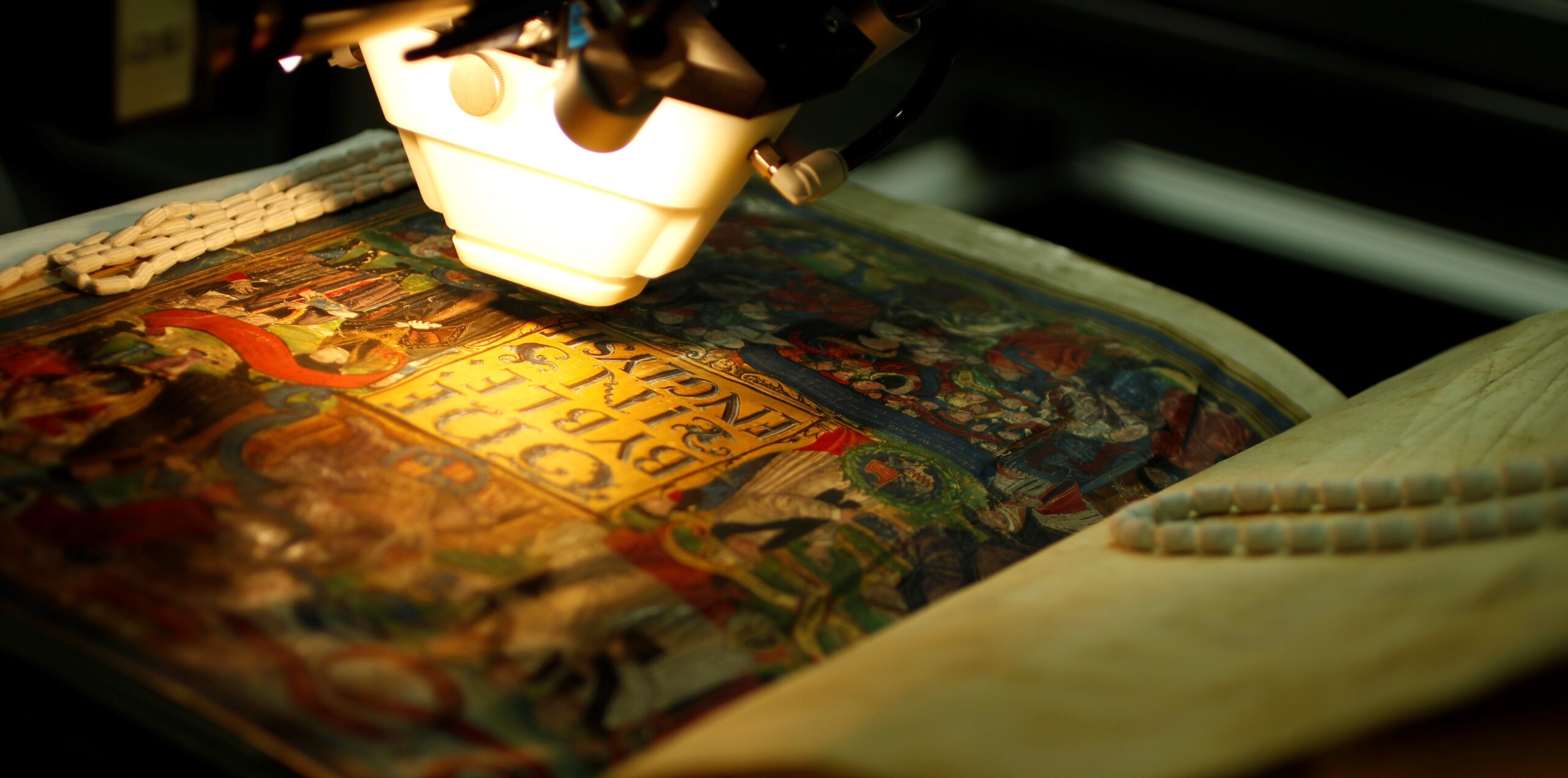
We have examined the title page of a presentation copy of the Great Bible (the first authorised English translation of the Bible), produced during the reign of Henry VIII. Scientific analysis has revealed how the images on the page were altered in response to shifting political circumstances.
A comparative study of three Christian devotional codices has examined whether it was possible to distinguish between material patterns of erasure which may reflect acts of iconoclasm directed at images or texts, and those that instead may represent devotional gestures of veneration.
Non-European Sacred Texts in Ritual Use
While much of the project has focused on Western codices, the third research strand has expanded the investigation to sacred texts used in other cultural contexts, particularly where texts are integrated into ritual objects and talismans.
One such text is a recently identified Nahuatl-Latin lectionary, written partly in Nahuatl, an Indigenous language of Mexico. Through chemical analysis, imaging, and contextual research, the project has sought to understand the manuscript’s material composition and historical context. The manuscript may represent one of the earliest known Catholic lectionaries written by an Indigenous Christian author.
Funding
The project is generously funded by the Arts and Humanities Research Council (AHRC)’s grant AH/X011224/1 (2024-2026).