Exhibitions
Scientific investigations into premodern books reveal new insights and enable us to tell new stories about objects which appeal to a broad audience. The Hidden in Plain Sight team were delighted that the results of their research featured in three major public exhibitions during the course of the project. It is not just the results of research that have wide appeal; the processes that underlie the discoveries are fascinating stories in their own right. In addition to contributing to the interpretation and presentation of objects in exhibitions, additional ‘behind the scenes’ content highlighting the team’s work was included in online resources and digital exhibition guides.
Six Lives: The Story of Henry VIII’s Queens
National Portrait Gallery, London, 20 June – 8 September 2024
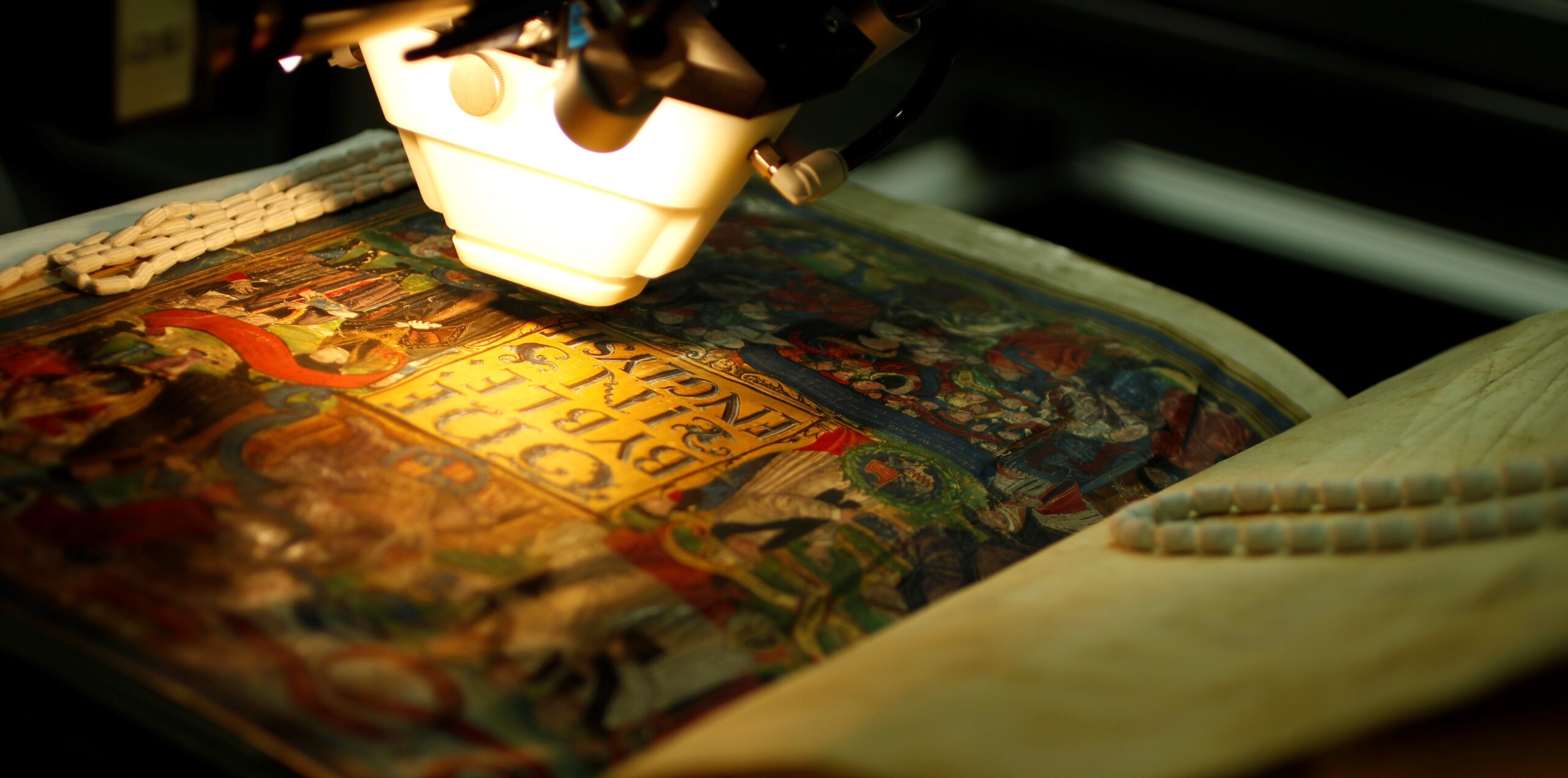
This exhibition, exploring the life, legacy and portrayal of Henry VIII’s six wives, featured the illustrated title page of the presentation copy of Henry VIII’s Great Bible belonging to St John’s College, Cambridge. The book was included after curators learned of its significance following our research.
The title page was printed, but then coloured by hand. Not all the painted images closely follow the print; we investigated their extent and materiality. The changes included the addition of the image of a noblewoman wearing cloth of silver and gold, which we believe to depict Jane Seymour, Henry’s beloved third wife. There is strong evidence that this and other changes was directed by Thomas Cromwell, Henry’s chief minister, after Jane’s death, to evoke her memory and posthumously demonstrate her support for the dissemination of the vernacular Bible.
Reunited: The Great Bibles of Henry VIII and Thomas Cromwell
National Library of Wales, Aberystwyth, 21 June – 22 November 2025
This exhibition brought together for the first time in almost five centuries the two presentation copies of the Great Bible, one prepared for Henry VIII and one for Thomas Cromwell. Although it’s not certain which book belonged to which man, the copy now belonging to St John’s College, Cambridge was exhibited alongside the National Library of Wales’ own copy, together with a selection of other Tudor books, documents and objects from the National Library’s own collection.
The exhibition explored the political and religious significance of the Great Bible, the first Bible in English mandated to be read in every church in England and Wales, and the particular power of images as propaganda in these presentation copies. It was striking to see the two books side by side and observe how identical printed images had been altered and manipulated by artists to convey religious and political messages.
Display panels in the exhibition gave an insight into some of the scientific methods and tools used by the project team to make their discoveries. A digital display screen enabled visitors to engage with further information on the project website.
The whole exhibition was collaboratively conceived, planned and funded by the HiPS project team and the National Library of Wales. The project team contributed to public events and the National Library of Wales engagement team designed and delivered a series of workshops for schools based around the exhibition.
Before the exhibition opened, there was also a rare opportunity for the project team to compare the two Bibles side by side and to conduct additional research and analysis which led to further discoveries about the production and adaptation of these complex books.
Secrets of the Thames: Mudlarking London’s lost treasures
London Museum Docklands, 4 April 2025 – 1 March 2026
This exhibition brought together objects found on the foreshore of the Thames which told a history of London from all periods. It also explored the experiences of modern mudlarks who find these items and the processes by which the items are identified. Among the items on display was the leather cover of a small 16th-century book, an extremely rare survival preserved by the Thames mud.
The HiPS project team worked collaboratively with curators and conservators at the London Museum for over a year in advance of the exhibition to learn more about this book cover, conducting many different types of scientific analysis. The results of this research fed directly into the presentation of the item in the exhibition.
Prof. Poleg gave more details about the team’s research and the significance of the object in an interview for the exhibition’s digital and audio guide.