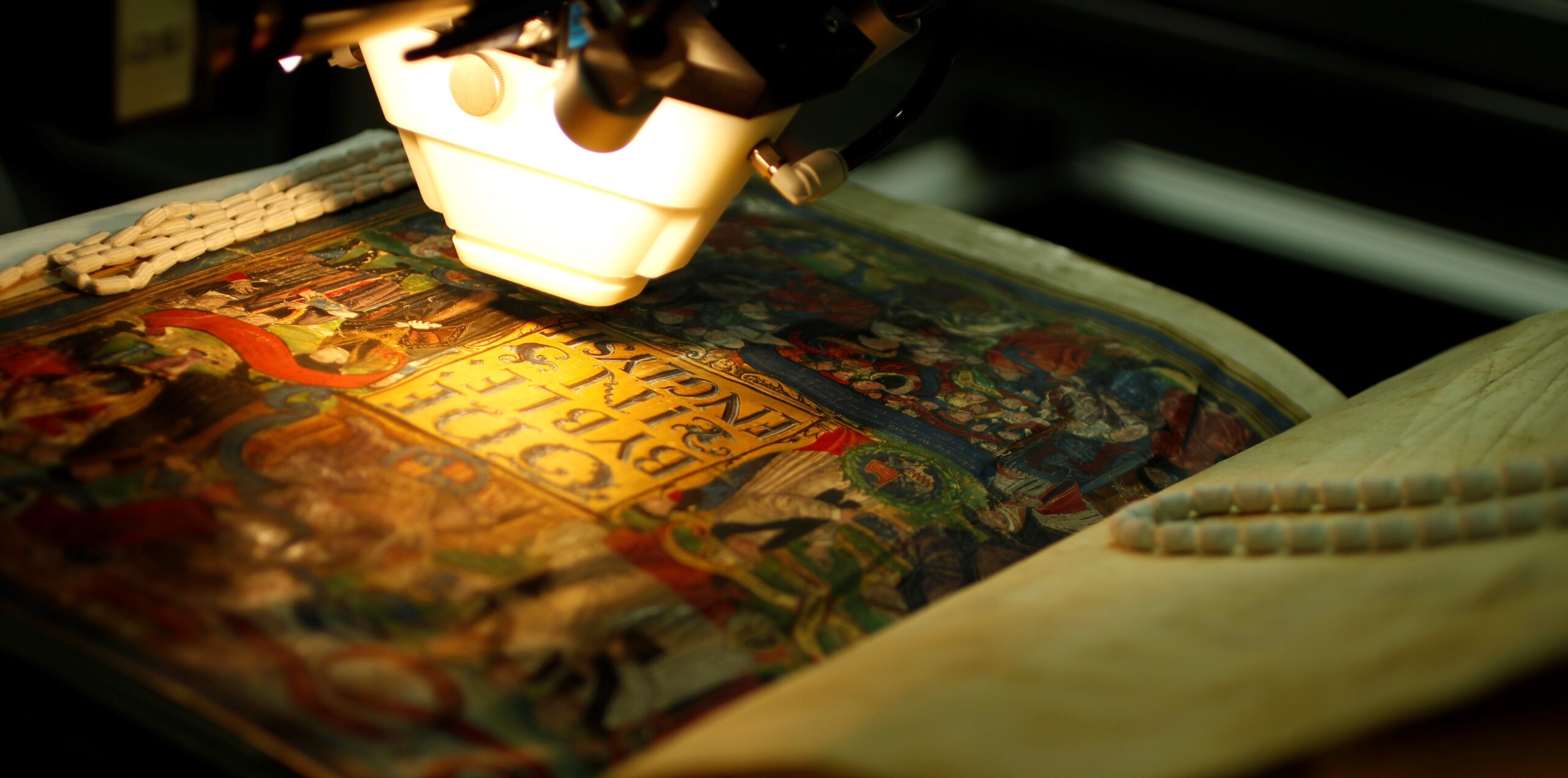
Submerged Binding
The foreshore of the Thames is a treasure-trove of historical artefacts, thrown to the river or lost on its banks. The anaerobic properties of its mud are especially auspicious for the preservation of organic material, such as wood and leather. Mudlarks, the women and men scouring the Thames foreshores for artefacts, pave new directions in the study of London’s history. Their work is now heavily regularised as they liaise with the Portable Antiquity Scheme and report new finds to the major museums.
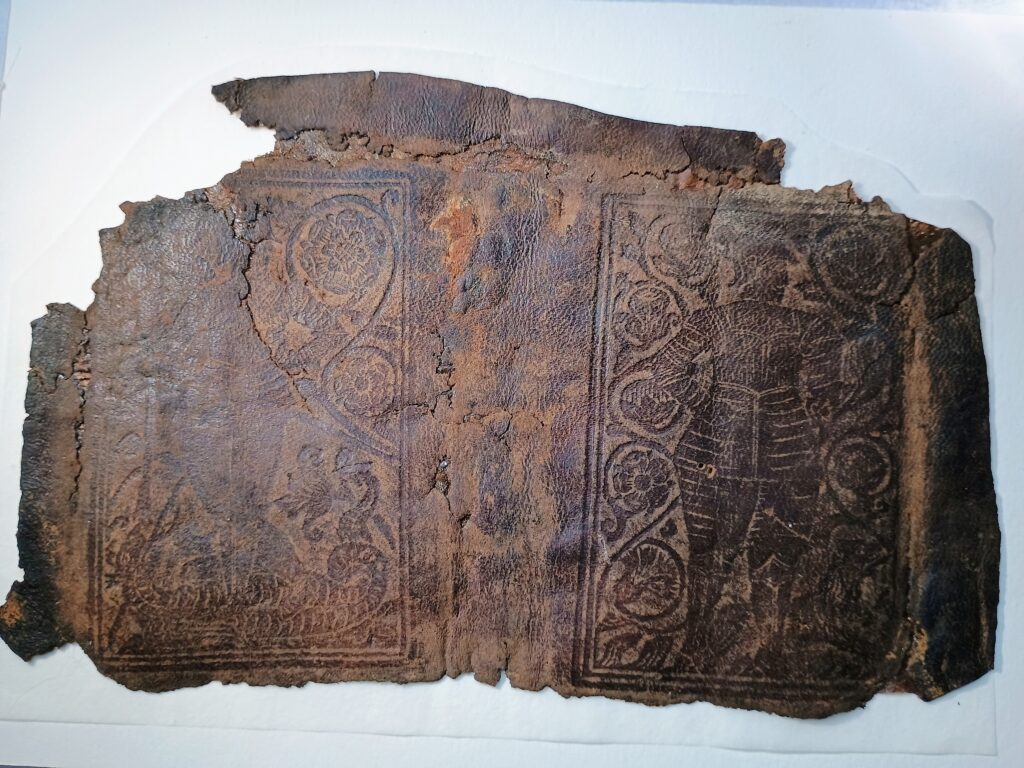
A folded piece of leather was found in the mud. When opened small fragments of wood fell from it. Initially kept immersed in water for conservation, it’s exact nature, use and date were unknown. The find was brought to the London Museum for initial assessment by Stuart White, Portable Antiquity Scheme Finds liaison officer and Kate Sumnall, Curator of Archaeology, recognising it as a premodern book binding, part of a book whose paper pages had been washed away. They then sought the support of the Hidden in Plain Sight team. It was brought for initial analysis at the Cultural Heritage Imaging Lab at Cambridge University Library, where it was photographed by Maciej Pawlikowski and examined by book conservator Edward Cheese.
Imaging was difficult, given the dark leather and the reflection of the water, but eventually revealed the details of the binding. The original binder applied metal heated stamps to the leather, resulting in images on the front and the back binding. These were, as shown through the complex imaging, of two knights in armour, one next to a dog, and the other slaying a dragon, a clear reference to St George. Both are on foot in an armour typical of the second half of the sixteenth century. This has assisted in providing a general dating for the binding. Further book-historical analysis by Eyal Poleg has revealed this to most likely be a unique survivor, with no similar bindings recorded.
The binding is unique in another way. Higher-end medieval and early modern books were bound with wooden boards, typically of oak, covered in leather. Lower-end books were at times covered in limp binding (leather or cloth), and, from early modernity, in bindings of paper pulp. This binding, on the other hand, utilised extremely thin wooden fragments to create a binding known at the time as scaleboard or scabbard. The use of such cheap bindings was frowned upon in early modernity. The Stationers’ Company fined binders using it in the sixteenth century, and existing samples are extremely rare.
The binding proved an excellent case study for the Hidden in Plain Sight project. A remnant of a premodern book with sacred iconography, nearly nothing was known of its time, use and context. It also formed part of a cheaper book, typically owned by merchants or the middling sorts. Such books are less likely to survive, as bequest and preservation patters among institutional libraries tend to favour larger and more expensive tomes. Deploying innovative technologies to help redress this imbalance fitted perfectly with the project’s remit.
A range of technologies, rarely employed in the study of early modern books, have been deployed by the project’s team. The wooden fragments, in particular, attracted considerable attention and were analysed using a variety of technologies. They were imaged in a micro-CT scanner, to retrieve tree rings. They were also sequenced for ancient DNA, aiming to provide information on the tree they were made of. Collaboration with Dr Peter Gasson and the Wood Identification team at the Royal Botanic Gardens, Kew, further explored using the fragments’ cellular structure to retrieve information about the tree species.

Further imaging has also been instrumental in supporting further analysis. After the binding has been professionally dried by Luisa Duarte, Archaeological Conservator at the London Museum more detailed imaging was possible. This has revealed not only minute details of the binding’s iconography, but also its folding and sewing patterns, supporting a better identification of the book once contained within it.
The collaborators on this study are now preparing its results for publication, showcasing the information retrieved and the innovative technologies — both successful and failed — deployed in its analysis. The binding was also displayed prominently in the Secrets of the Thames exhibition. This major exhibition, curated by Kate Sumnall, celebrates the diverse objects retrieved from the Thames, the mudlarks finding them, and the history they narrate. As part of mounting the exhibition, Charlie Dixon, mudlark and illustrator, created an impression of the binding, assisting audience members in appreciating is still partially hidden iconography.