CEREES Panel
Belarus Studies at Times of Revolution and War
Location: Montagu Lecture Theatre, Graduate Centre, Queen Mary University of London
Date: 16 February, 18:00-20:00
Register here
Description:
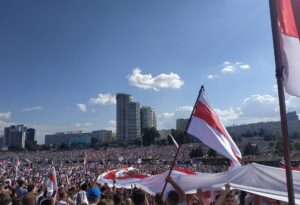
The (as yet) unfinished revolution of 2020 became a turning point in contemporary Belarusian history. The mass protests and their violent suppression permanently altered the relationship between Belarusian society and Europe’s longest-surviving authoritarian regime, that of Aliaksandr Lukashenka. The geopolitical fallout has been significant, sealing Lukashenka’s dependency on the Kremlin and precipitating Russia’s full-scale invasion of Ukraine. But these traumatic events also had a transformative impact on Belarusian studies, galvanising scholarly and public interest in the previously overlooked former Soviet republic.
This panel brings together four experts on Belarusian history, politics, and culture to showcase some of their latest research and to share their insights into the state of the field at a time of crisis and uncertainly for Belarus and Europe.
Speakers:
Dr Aleksandra Pomiecko (King’s College London) is a Lecturer in Modern History. Her research has explored banditry and insurgency in Eastern European borderland regions after the First World War and transnational Belarusian networks and actors in the twentieth century. She is the author of the book Bound by Exclusion and Violence : A History of Belarusian Armed Struggle in the Twentieth Century (University of Toronto Press, 2025), as well as journal articles and book chapters on twentieth-century Belarusian history. She received her PhD from the University of Toronto and her MA at Uniwersytet Jagielloński.
Dr Paul Hansbury is the author of the book Belarus in Crisis: From Domestic Unrest to the Russia-Ukraine War (Hurst/Oxford University Press 2023). His most recent academic post was as part of the University of Warwick’s Ukraine-Belarus Hub (WUB Hub), and he is currently writing a book about US-Russia relations. He received his PhD from St Antony’s College, University of Oxford.
Dr Natalya Chernyshova (QMUL) is Senior Lecturer in Modern European History at Queen Mary University of London, where she teaches on Soviet, Belarusian, and Ukrainian history as well as the Cold War. Her research and publications focus on post-WW2 Belarusian history, Soviet nationalities politics, and everyday life during late socialism. Her most recent article on the politics of modernisation in late Soviet Belarus was published in November 2025 in Europe-Asia Studies. She is currently writing her second book, The Most Soviet Republic: Belarus in the Long 1970s (research funded by a British Academy Mid-Career Fellowship, 2020-2022). Natalya has commented on history and current affairs in Belarus and the wider region for the BBC, The Times, History & Policy, France 24 Online, The Conversation and other media in the UK and internationally.
Darya Lis (QMUL/BL) is a PhD student working on a project ‘Reframing Postcolonial Discourse in East European Studies: The Case Study of the Belarus Collection at the British Library’. Her research focuses on the construction and discontents of Belarusian national identity, drawing critically on the Belarusian materials at the British Library and testing the suitability of the decolonisation framework for Belarus. The research is fully funded by the prestigious AHRC Collaborative Doctoral Partnership award in partnership with the British Library. Darya is jointly supervised by Dr Natalya Chernyshova (QMUL), Dr Katya Rogatchevskaia (BL), and Dr Olga Topol (BL).
